Building a Digital Foundation: The Power of a Specialized Construction Company Website
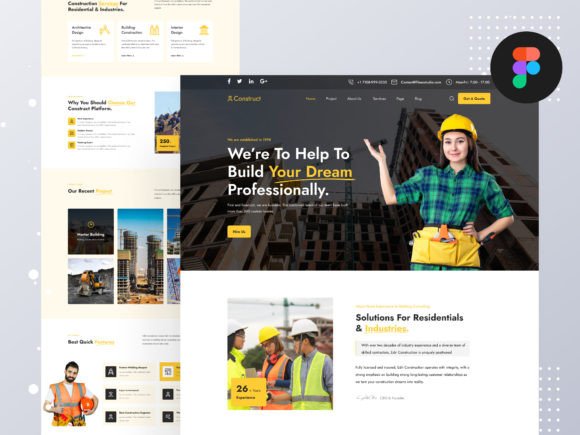
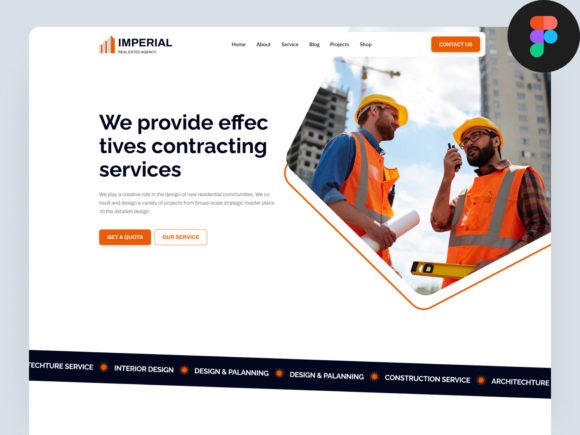
In the modern business landscape, the first handshake often happens on a screen rather than a job site. For firms operating in heavy industries like building construction, office development, and infrastructure projects, a robust online presence is no longer optional—it is a critical asset. A well-crafted Construction Company Website serves as the digital blueprint for your brand, communicating reliability, expertise, and vision to potential clients before you ever exchange a business card.
While the core of the industry remains rooted in physical structures, the pathway to securing those projects has shifted dramatically. Decision-makers, whether they are real estate developers, corporate executives looking for office construction, or private investors, begin their search online. They are not just looking for a contractor; they are looking for a partner who understands the complexities of real estate consultation, financial planning, and project management. Your website must reflect this multifaceted capability.
Beyond the Blueprint: Integrating Diverse Services
One of the most significant advantages of a modern web platform is the ability to showcase a holistic suite of services. Historically, construction firms might have been siloed into specific trades. Today, however, the most successful entities offer end-to-end solutions. Your digital home should mirror this evolution.
Consider the client who needs more than just bricks and mortar. They may require marketing consulting to position their new development, advertising consulting to sell units before completion, or specialized financial advisors to structure the deal. A sophisticated Construction Company Website allows you to present these ancillary services alongside your core building capabilities. By highlighting connections with insurance brokers and investment consultants, you position your firm as a central hub for project success.
This integration is particularly vital for large-scale endeavors like office construction or commercial complexes. These projects involve layers of bureaucracy, funding, and human resources. Featuring sections dedicated to HR consulting or workforce management demonstrates that you understand the human element of construction, not just the structural one. When a visitor sees that you can facilitate the entire lifecycle of a build—from financial structuring to final marketing—they are far more likely to engage your services.
The Role of Design in Establishing Trust
Trust is the currency of the construction industry. Clients entrust firms with millions of dollars and years of their time. Consequently, the aesthetic and functional quality of your website directly influences perceived trustworthiness. A cluttered, outdated, or broken site suggests a lack of attention to detail—a fatal flaw in an industry where precision is paramount.
Modern users expect a minimal modern design that loads quickly and looks impeccable on any device. With the majority of research now conducted on tablets and mobile phones while on-site or in transit, responsiveness is non-negotiable. A template built on a Bootstrap Grid System or a 1170px grid ensures that your content aligns perfectly whether viewed on a 27-inch monitor in a boardroom or a smartphone at a excavation site.
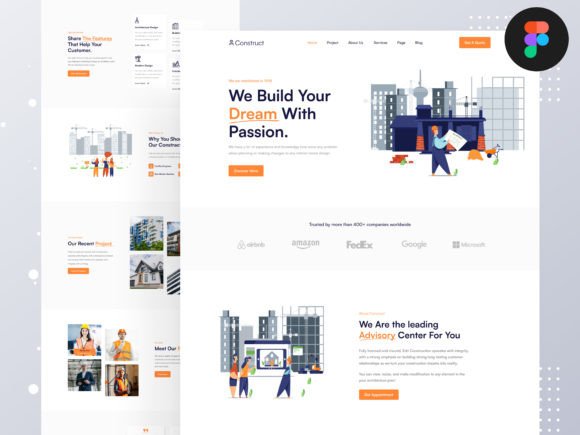
Visual hierarchy plays a crucial role here. Using vector icons and amazing vector illustrations helps break down complex processes into digestible visual stories. Instead of walls of text, potential clients can scan through clearly defined service areas. When every layer is named and grouped properly in the design phase, the resulting code is cleaner, faster, and easier to maintain. This technical cleanliness translates to a smoother user experience, reinforcing the message that your company is organized and professional.
Customization and Scalability
No two construction firms are identical. One might specialize in high-rise residential towers, while another focuses on industrial warehouses or retrofitting historical buildings. Therefore, a "one-size-fits-all" approach rarely works. The ideal Construction Company Website is built on a foundation of 100% customizable Figma files.
Having access to unique artboards and fully vector-customizable elements means you can adapt the site as your business grows. Perhaps you decide to expand into real estate consultation next year; with a modular design, adding a new section is seamless. The ability to easily find artboards, folders, and components saves countless hours for web developers and marketing teams alike.
Furthermore, utilizing free fonts from Google Fonts ensures that your typography remains consistent and legible across all browsers without incurring licensing fees. This attention to typographic detail enhances readability, ensuring that your project descriptions and case studies are consumed exactly as intended.
Technical Excellence Meets Creative Vision
The backbone of a high-performing site lies in its technical architecture. Best practices in web development dictate that sites should be built with speed and SEO in mind. A layout based on a full-width 1600px design allows for immersive imagery, showcasing your completed projects in all their glory. High-resolution photos of finished office constructions or intricate architectural details need space to breathe.
However, beauty cannot come at the cost of function. The underlying code must be semantic, using proper heading structures (H1, H2, H3) to help search engines understand your content. This is where the organization of the design file matters. When a designer delivers a file with well-organized layers, the developer can translate that directly into clean HTML and CSS. This reduces bloat, improves load times, and boosts your ranking in search results for terms like "building construction" or "investment consultants."
Moreover, the inclusion of creative and unique design elements sets you apart from competitors who rely on generic themes. In a saturated market, distinctiveness is key. Custom vector illustrations can depict your workflow, safety protocols, or sustainability efforts in a way that stock photography never could. These unique assets become part of your brand identity, making your Construction Company Website memorable.
Adapting to Modern Workflows
The construction industry is increasingly digital. Project managers use cloud-based tools, architects collaborate in real-time via 3D models, and clients expect transparent communication. Your website should act as the portal to this modern workflow.
Imagine a scenario where a potential investor lands on your site looking for financial advisors related to a new development. They find a dedicated page explaining your partnership with top-tier investment consultants, complete with clear calls to action and easy-to-understand graphics. Or consider a corporate client seeking office construction who needs assurance about your HR capabilities. A well-structured section detailing your workforce management and safety training can seal the deal.
By integrating these diverse elements—marketing consulting, advertising consulting, and insurance brokers—into a cohesive narrative, you demonstrate that you are forward-thinking. You aren't just building structures; you are building businesses. This perspective resonates deeply with modern clients who value efficiency and comprehensive support.
Making the Right Choice for Your Digital Presence
When evaluating options for your online platform, look beyond the surface. Ask yourself if the template or design system offers the flexibility you need. Does it come with 01 unique artboards that allow for distinct page layouts? Is it based on a reliable grid system like Bootstrap? Can you easily swap out icons and illustrations to match your specific branding?
The availability of a single, comprehensive Figma File containing all these elements is a massive advantage. It streamlines the handover from design to development, reducing errors and speeding up launch times. It empowers your internal team to make updates without needing to hire external agencies for minor tweaks. Whether you are updating a list of real estate consultation partners or adding a new gallery of completed projects, having full control over the source files is invaluable.
Ultimately, your website is your most powerful sales tool. It works 24/7, reaching audiences globally. By investing in a highly customizable, modern UI driven platform, you ensure that your digital presence is as solid and enduring as the structures you build. From the initial concept in Figma to the final pixel on a mobile screen, every element should contribute to a narrative of excellence, reliability, and innovation.
In an era where building construction intersects with finance, marketing, and human resources, your website must be the bridge that connects all these disciplines. It should be a dynamic, living document of your capabilities, ready to adapt to the changing needs of the market. With the right foundation—built on best practices, unique design, and technical precision—you can construct a digital legacy that stands the test of time.